The Misleading Nature of Military Death Rates May 26, 2026
Posted by Chris Mark in Uncategorized, War, weapons and tactics.Tags: Band of Brothers, Eighth Air Force, History, MACV-SOG, Military History, politics, Risk Analysis, statistics, Submarine Warfare, vietnam, Vietnam War, War, WWII
add a comment
Someone on Memorial day posted on social media that submariners suffered the highest death rate of any American service in World War II. As a comat veteran who holds Memorial Day as a somber occasion it caused me to pause and think. While the raw stats suggest that the statement is true, is also very nearly meaningless as a statement about danger — and understanding why is one of the most useful lessons in how a single, accurate number can completely mislead you.
The American submarine force was small. Roughly 16,000 men made war patrols, and about 3,500 of them never came home, with 52 boats lost. That works out to a fatality rate near 22 percent — the highest of any U.S. branch. Historian Donald Miller, in Masters of the Air, makes the point bluntly: of all the branches of the American armed forces, only submarine crews had a higher fatality rate than his bomber boys, at almost 23 percent.
Now set that against the Eighth Air Force, which lost about 26,000 men killed — more fatalities than the entire United States Marine Corps. In raw numbers, the bomber campaign looks far deadlier than the silent service. Both pictures are accurate. They simply measure different things, and neither one, by itself, tells you how dangerous it was to actually do the job.
Rate Versus Count
The first trap is confusing a rate with a count. “Highest death rate” is a proportion: deaths divided by everyone who held the role. “Most deaths” is a raw tally. A small, lethal specialty can top the rate chart while contributing a tiny share of total deaths, simply because its denominator is small. That is exactly the submarine service — a few thousand deaths out of a few thousand men produces a brutal percentage.
The bomber force generates the opposite illusion. The 26,000 dead is a frightening number, but 350,000 men served in the Eighth Air Force, and most of them were ground crew and support staff who were never in danger. Measured against the 210,000 who actually flew combat, the death rate was about 12.4 percent. Measured against everyone in uniform, it falls to around 7 percent. The raw body count reflects the size of the force, not the danger of the seat.
So once we strip out the size disparity and compare combat men to combat men, the submariner — at roughly 22 to 23 percent — was in the statistically deadlier billet, and the bomber crews, at about 12 percent, come second. If a death rate were the same thing as danger, we could stop here.
It isn’t.
Danger Lives in the Exposure, Not the Total
A death rate is a cumulative number — the odds you eventually died, summed over your entire time in the role. What it conceals is the variable that actually defines danger: how much risk you absorbed per unit of exposure, and how much exposure you were forced to take. Epidemiologists separate these as cumulative incidence (did you die at all) versus the hazard rate (how lethal each moment was). War tells the same story.
A bomber crew’s exposure was tightly capped. A tour was 25 missions early in the war, later raised to 30 and then 35. Each mission ran about six to nine hours; the famous Memphis Belle logged 148 hours across her 25 missions, under six hours apiece. Complete the longest tour and you had spent, at most, around 245 hours in the air — roughly ten days of cumulative flying. That cap is the entire reason the cumulative death rate looks “only” moderate. Per hour aloft, the danger was savage. In the brutal 1942–43 period, of the men who flew the original 25-mission tour, only about a third survived it; by October 1943, fewer than one in four crewmen could realistically expect to finish. The job didn’t become survivable until escort fighters won air superiority — by 1945, 81 percent completed a full 35-mission tour.
A submariner, by contrast, accumulated his 22 percent over an enormous span of time. A single war patrol lasted six to eight weeks — a thousand hours or more continuously inside the kill zone — and most men made several. So while the submariner’s lifetime odds were worse, the bomber crewman faced a far higher chance of death per hour of combat, by something on the order of five to ten times. The two jobs were lethal in opposite shapes: the submarine was a long, grinding exposure; the bomber was a short, concentrated burst of extreme danger, repeated until your luck or the war ran out.
This is the heart of the matter. A short tour with a horrific per-mission hazard and a long tour with a milder per-hour hazard can land on the very same headline death rate. The number hides which one you were.

Figure 1. Approximate death rate per hour of combat exposure. The submarine held the worse lifetime odds, but a bomber crewman faced roughly eight times the risk per hour in the air.
MACV-SOG: The Law of Small Numbers at Its Deadliest
If you want the purest illustration of how exposure and small denominators distort a death rate, look at the most dangerous billet of the modern era: the covert reconnaissance teams of the Military Assistance Command, Vietnam – Studies and Observations Group (MACV-SOG).
During the Vietnam war SOG teams ran cross-border missions into Laos, Cambodia, and North Vietnam in tiny “spike teams” — typically two or three Americans led by a “One-Zero” plus a handful of indigenous troops. Its recon men posted a casualty rate that exceeded 100 percent, described as the highest sustained American loss rate since the Civil War. In 1968, every SOG recon man was wounded at least once, and about half were killed.
Two statistical points make SOG essential to this discussion. First, the denominator was minuscule — of roughly 2,000 men who served in SOG, only about 400 to 600 actually ran recon and direct-action missions. This is the law of small numbers: tiny populations produce extreme, volatile rates that large forces never show. A rate above 100 percent is impossible for a big army and routine for a few hundred men hit repeatedly. Second, that 100-plus percent is a casualty rate — killed plus wounded — and it tops 100 only because individual men were wounded multiple times. Apply the same discipline we used on the bombers and the death rate among recon men sits closer to half in the worst years. The categories matter, and conflating “casualty” with “killed” is how the number gets abused.
SOG also fits the bomber pattern in a way worth naming: it was all-volunteer, and its danger was delivered in a relatively small number of discrete missions, each lasting only days, rather than spread thin across a long deployment. The lethality was per-mission, and per-mission it was off the charts. (The flip side of that intensity: SOG recorded a kill ratio of 158 to 1 in 1970, the highest in U.S. military history.)
Easy Company: When Replacements Hide the Body Count
The final distortion is the one most people miss, and the Band of Brothers company illustrates it perfectly. E Company, 506th Parachute Infantry Regiment, jumped into Normandy, Holland, and Bastogne. It was formed at Camp Toccoa with about 140 men. By the end of the war, 366 men had served in its ranks, and 49 were killed in action.
Run the naive math and you get a death rate around 13 percent — comparable to bomber aircrew, and apparently far less dangerous than the submarine service. That number is a lie of the denominator. The company’s standing strength was only about 140, yet 366 men cycled through it. Easy was effectively destroyed and rebuilt more than twice over. It jumped into Market Garden with 154 men and came out with 98; it had already taken 65 casualties in Normandy. Counted against the men who were actually present at any given moment, the company suffered well over 100 percent casualties. The 13 percent figure is diluted because the denominator kept refilling with fresh replacements who hadn’t yet been hit.
Notice, too, that almost no Easy Company men became prisoners — like the submariners, their losses converted into killed and wounded rather than capture. A downed bomber crewman could parachute and survive as a POW; an infantryman in a Bastogne foxhole or a submariner in a sinking boat had no such exit. The shape of the casualties is as informative as the count.
So How Do You Actually Measure Danger?
A headline death rate flattens at least three distinct things into one misleading figure: the intensity of each exposure (per mission, per hour), the duration of exposure (how long, how many times you went out), and the denominator (small units and replacement churn that warp the percentage). The submarine looks worst by lifetime odds. The bomber looks worst per hour of combat. SOG looks worst per mission and shows how small numbers break the scale entirely. Easy Company shows how a steady stream of replacements can bury the true cost inside a tame-looking percentage.

Figure 2. The four headline death rates as commonly cited. Each is measured on a different basis — a peak year versus the whole war, a small recon subset versus everyone who served, and a figure diluted by constant replacements. Lined up as equals, they invite exactly the false conclusions this article warns against.
The honest question was never “what fraction of them died.” It is “how likely was a man to die each time he went out, and how many times was he made to go.” Answer those two, and the statistic finally tells the truth. Quote only the first number, and you can prove almost anything — including that the deadliest jobs of the war weren’t very dangerous at all. On Memorial day, remember those who gave all for our freedoms. Whether they were killed in combat or died in training. They all served and died for us.
References
- Miller, Donald L. Masters of the Air: America’s Bomber Boys Who Fought the Air War Against Nazi Germany. Simon & Schuster, 2006. (Eighth Air Force fatalities; submarine fatality comparison; tour-completion statistics.)
- 398th Bomb Group Memorial Association, “One in Twenty — The 398th’s Killed in Action.” (12.38 percent mortality among 210,000 combat aircrew; tour-survival rates by year.) https://www.398th.org/History/KIA/index.html
- Office of the Surgeon General, U.S. Army. Wound Ballistics in World War II, Chapter 9 — Eighth Air Force battle-casualty survey. (MIA resolution: roughly 40 percent killed, 60 percent survived as POW, wounded, or evaders.) https://achh.army.mil/history/book-wwii-woundblstcs-chapter9/
- Plaster, John L. SOG: The Secret Wars of America’s Commandos in Vietnam. Simon & Schuster, 1997. (Recon casualty rates; team structure; cross-border operations.)
- HistoryNet, “How Top-Secret Commando Unit SOG Took on the Most Dangerous Missions in Vietnam.” (Casualty rate exceeding 100 percent; 1968 figures; 158-to-1 kill ratio.) https://www.historynet.com/studies-and-observations-group-vietnam/
- The National Interest, “Inside the Daring Missions of MACV-SOG.” (Approximately 2,000 served in SOG; 400–600 ran recon and direct action.)
- Ambrose, Stephen E. Band of Brothers: E Company, 506th Regiment, 101st Airborne from Normandy to Hitler’s Eagle’s Nest. Simon & Schuster, 1992. (Market Garden strength figures; Normandy and Bastogne casualties.)
- TogetherWeServed, “Famous Army Unit: Easy Company, 506th Infantry Regiment.” (140 original members; 366 total served; 49 killed in action.)
Note: Figures for elite and small units, especially SOG, are frequently dramatized. Where casualty rates exceed 100 percent, that figure reflects killed plus wounded (with multiple woundings per man), not a death rate. Comparisons above use matched combat populations wherever possible.
Technology Anxiety Is 2,400 Years Old. AI Is Just the Latest Target. May 19, 2026
Posted by Chris Mark in Uncategorized.add a comment
A friend recently showed me a Facebook post arguing that AI was invented by the devil and will destroy the world. He was half-laughing, half-baffled. Welcome to the oldest pattern in technology discourse. I had to write about this….
Around 370 BCE, in his dialogue Phaedrus, Plato has Socrates tell a story about the Egyptian god Theuth, who presented the gift of writing to King Thamus. Theuth pitched it as “an elixir of memory and wisdom.” Thamus wasn’t impressed. Writing, he warned, would “produce forgetfulness in the minds of those who learn to use it, because they will not practice their memory.” Worse, students would appear to know much when for the most part they knew nothing, having acquired the appearance of wisdom instead of wisdom itself. History of InformationLitCharts
The irony is foundational: we only know Socrates’ critique of writing because Plato wrote it down. The technology he feared became the technology that preserved his fear of it. Every generation since has performed some version of this same move.
In 1545, the Swiss scholar Conrad Gessner compiled the Bibliotheca Universalis, an attempt to catalog every printed book in Europe. In the preface, he complained about the “confusing and harmful abundance of books” unleashed by Gutenberg’s printing press. The same printing revolution that gave us mass literacy, modern science, and the spread of medical knowledge was, to a serious scholar of the day, an overwhelming threat to the mind. Blogger
In the 1700s, the French statesman Malesherbes argued that newspapers were socially isolating readers and detracted from the spiritually uplifting group practice of getting news from the pulpit. People used to gather to learn the news together. Now they read it alone. He saw this as the decay of civic life. Slate
In 1881, American neurologist George M. Beard published American Nervousness, in which he identified the telegraph as a primary cause of a new disease he called “neurasthenia.” “Before Morse, merchants worried much less,” he wrote. Now stock prices and disasters from distant cities arrived instantly, overwhelming the nervous system. The telegraph, in his diagnosis, was making Americans literally sick. News Directory 3
In 1883, the medical journal The Sanitarian warned that schools “exhaust the children’s brains and nervous systems with complex and multiple studies, and ruin their bodies by protracted imprisonment.” Universal literacy — the thing Socrates feared, that Gessner feared, that we now consider the baseline of civilization — was, when actually implemented, considered a leading cause of madness. Slate
In 2008, journalist Nicholas Carr published Is Google Making Us Stupid? in The Atlantic, arguing that the internet was eroding our capacity for deep reading and sustained attention.
Now it’s AI. The current generation of anxiety has its target. Within ten years it will be something else.
The pattern is not subtle. Every transformative technology produces a class of people who immediately predict it will destroy something essential — memory, attention, sociality, reason, the soul. They are sometimes partially right; the technology does change behavior in ways the previous order finds disorienting. They are mostly wrong in scale and direction; the apocalypse never arrives, the new technology becomes the new baseline, and the same cognitive machinery rotates to the next target.
This does not mean every concern about technology is hysteria. Some are legitimate. Real critiques of AI — about labor displacement, about concentrated corporate power, about fabrication in consequential domains — deserve serious engagement. The point is to distinguish substantive analysis from reflexive anxiety dressed in metaphysical language. “AI is the devil” is not analysis. It is the same response Thamus had to writing, in updated vocabulary.
Three useful questions when someone makes a sweeping claim that a new technology will destroy us:
First, does the same person rely on previous technologies that earlier generations also predicted would destroy us? Books, newspapers, electricity, telephones, television, computers, the internet, smartphones, GPS, online banking. The same person typing “AI will destroy us” into Facebook is using a global network of data centers, recommendation algorithms, and personal devices that consume vastly more energy than the AI training they are objecting to. If the position is really about energy, attention, or autonomy, the existing technologies should be at least as alarming as the new ones. They are not, because the position is not really about those things. It is about novelty.
Second, is the prediction specific and falsifiable, or is it metaphysical? “AI will produce confidently fabricated outputs that cause measurable harm in quantitative work” is a specific, testable claim that I have written about elsewhere. “AI is from the devil” is not. The first earns a serious response. The second is a costume worn by an emotion.
Third, who benefits from the apocalyptic framing? Apocalyptic predictions sell better than measured ones. They get clicks, fund careers, build movements. That does not automatically make them wrong, but it should adjust the weight given to them — particularly when the predictor has no operational experience with the technology they are predicting will end civilization.
Socrates was a brilliant man. He was also wrong about writing. The civilization that emerged on the foundation of literacy — including the preservation of his own thought — is the rebuttal. He had no way to see that, because he was inside the moment of transition, where the costs of the new technology were visible and the benefits were not yet imaginable.
We are inside that same moment with AI. Some of the costs are visible. Some are real. The benefits — for those who learn to use the tool well, and not as a substitute for thinking — are still mostly latent, surfacing in ones and twos as practitioners figure out how to operate the new instrument.
The question is not whether the new technology will change us. It will. Every transformative technology does. The question is whether we will be Thamus, warning everyone that the children will forget how to remember, or whether we will be the ones who learn to use the new tool well enough that the next generation takes it for granted — and then panics about whatever comes after.
Defining Security: Insights from New Scholarly Research October 31, 2025
Posted by Chris Mark in Uncategorized.Tags: security definition risk management security theory mathematical formulation threat modeling operational security security frameworks conceptual frameworks
add a comment
I just published my latest book on Amazon. This one is called Defining Security; A Hierarchical Framework for Language, Mathematical Formulation, and Security Practice. It explores the definition of security and delves into the complexity of the subject.

“Security practitioners and scholars have struggled for decades to establish precise, universally accepted definitions of fundamental security concepts. This whitepaper examines the definitional challenges facing the security profession, drawing from doctoral and professional research that identified approximately 25 distinct definitions of security among over 200 practitioners. Following Socrates’ priority of definition—that one must first know what a property is before knowing anything else about it—this paper establishes operational definitions for security, risk, threat, vulnerability, asset, and controls. These definitions integrate insights from Manunta’s seminal work on security conceptualization with practical frameworks developed through professional security practice. The paper explores the distinction between denotative and connotative meanings, examines why security professionals often resort to apophatic definitions (defining security by what it is not), and presents mathematical formulations that enable systematic analysis. By establishing definitional clarity, this work provides a foundation for improved communication among security professionals, more rigorous security methodology, and better evaluation of security measures and performance.”
“The War God’s Face has Become Indistinct”- Updated Whitepaper on Unrestricted Warfare October 21, 2025
Posted by Chris Mark in Uncategorized.Tags: Academic Exploitation, china, cold war, Cyberattacks, Unrestricted Warfare, Volt Typhoon
add a comment
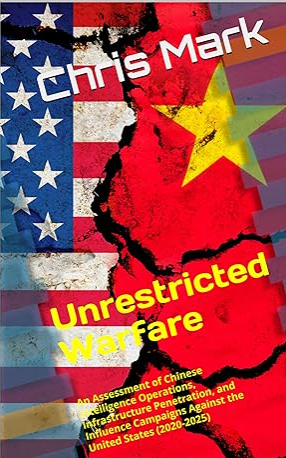
I recently updated and republished a paper on Unlimited or Unrestricted Warfare Doctrine against the US. I first wrote on this in 2013 for The Counter Terrorist Magazine and have been keeping the concept updated. Here is a summary…:
“This comprehensive assessment examines the implementation of China’s unrestricted warfare doctrine against the United States from 2020-2025. Developed by PLA Colonels Qiao Liang and Wang Xiangsui following the 1991 Gulf War, unrestricted warfare represents a paradigm shift from conventional military confrontation to asymmetric operations across multiple domains.
This study analyzes documented Chinese operations including: Volt Typhoon’s five-year penetration of critical infrastructure systems; Salt Typhoon’s compromise of nine major U.S. telecommunications companies affecting over one million users; systematic academic infiltration through Confucius Institutes and intellectual property theft costing an estimated $500 billion annually; congressional penetration operations targeting rising political figures and senior officials; and state-level influence campaigns exemplified by the Linda Sun case.
The analysis demonstrates how China employs cyber operations, political influence, academic exploitation, and infrastructure pre-positioning to achieve strategic objectives while avoiding direct military confrontation. Drawing on government reports, intelligence assessments, and primary source materials, this work examines the doctrine’s principles of asymmetry, omnidirectionality, and minimal consumption as manifested in contemporary operations. The study concludes that unrestricted warfare represents a coherent strategic framework specifically designed to neutralize American conventional military advantages by exploiting vulnerabilities in open democratic societies.”
Digital Impersonation on OnlyFans: Is it Possible? October 20, 2025
Posted by Chris Mark in Uncategorized.Tags: ai, artificial-intelligence, authentication, Biometric, blockchain, cybersecurity, Digital Impersonation, News, OnlyFans, technology
add a comment

Recently, I was personally accused of “digitally impersonating” someone to set up an OnlyFans in their name! Let me be clear. #1…I would NEVER do that and #2…it is NOT possible (well..it approaches mathematical impossibility. But, I digress). Because I know this person and I know technology, when it was exposed, I was the easy target…sooooo…. I took the opportunity to actually do a study on OnlyFans authentication architecture! (because I am a cyber nerd) The findings are mind blowing! Outside of financial institutions, OnlyFans has one of the, if not THE, most robust authentication architecture in the industry! Read the entire paper here! Good Job OnlyFans! Of to court we go!!
Here is a summary of the findings…
“This analysis examines OnlyFans’ multi-layered verification system to demonstrate how multiplicative security controls create exponential attack complexity. The platform employs three sequential, mandatory verification layers: document verification (government ID analysis), biometric verification (liveness detection and facial matching), and banking verification (KYC/AML compliance through financial institutions).
Using a multiplicative probability model, the analysis calculates that attackers face dramatically reduced success rates. Unsophisticated attackers have only 0.003% success probability (1 in 33,000 attempts), while even sophisticated attackers using professional forgeries and advanced deepfakes face just 0.21% success rates (1 in 476 attempts). This represents a 452-fold security improvement over single-factor systems.
Banking verification emerges as the critical control, providing a 28.6× security multiplier due to independent organizational oversight, regulatory requirements, and specialized fraud detection infrastructure.” (read the rest here!) I hope you read the article!! It is actually a great read for us nerds!
