Roque Wave; Secure Payments Article January 11, 2012
Posted by Chris Mark in InfoSec & Privacy, Laws and Leglslation.Tags: Chris Mark, InfoSec, InfoSec & Privacy, mark consulting group, markconsultinggroup.com, PCI, PCI DSS, risk management, roque wave, secure payments, security
add a comment
This is an excerpt from an article I wrote a couple of years ago called “The Rogue Wave”. It discusses a high level overview of Doctrine, Tactics and Strategy and applying PCI DSS as doctrine…You can read the full article here.

“Recent data compromises have continued to illustrate the challenges of securing data in an increasingly hostile environment. Companies are faced with securing and protecting their valuable information form a growing number of increasingly sophisticated and organized groups determined to steal valuable data. Historically, the response to data compromises has been to pass and enforce increasingly strict standards, regulations, and laws detailing the specific steps companies must take to protect data and the required disclosure should data be compromised. Those companies that are the unfortunate victims of data thieves are criticized and vilified for “losing data”. In spite of the efforts being focused upon compliance with the various laws and standards, data compromises continue in their steep upward trend seemingly unabated…”
Standards Aren’t Security and We Shouldn’t Expect Them to Be January 11, 2012
Posted by Heather Mark in InfoSec & Privacy, PCI DSS.Tags: cybersecurity, Heather Mark, ISO, mark consulting group, markconsultinggroup.com, PCI DSS, privacy, regulatory compliance, standard
add a comment
 Today I saw an article about the PCI DSS in which the author lamented that, although progress had been made, there were still significant flaws in the Payment Card Industry Data Security Standard. I have seen a great many articles centered on the same idea: Though good in theory, the PCI DSS is just too flawed to work. I would argue that, in many ways, the PCI DSS is doing exactly as it is intended. Now, I do have to take off my academia hat here a bit and admit that, without a comprehensive policy and program evaluation, it is simply not possible to accurately determine the efficacy of the standard. We cannot determine that a certain population of individuals has been spared identity theft as a result the implementation of PCI DSS or rising compliance rates. What we have is anecdotal evidence that, despite the best efforts of the card brands, the Qualified Security Assessors and everyone involved in the payment transaction chain, data breaches continue to occur and may even be growing, in terms of frequency and magnitude. Since anecdotal evidence seems to be the central data point in these arguments, I’d like to share some anecdotal evidence of my own.
I’ve been involved in the payment card industry, and specifically in the security side of it, for too many years to admit. When we began working with Visa’s Cardholder Information Security Program (CISP), the predecessor to the PCI DSS, many companies had no data security programs in place. In fact, we would often see global ecommerce companies that didn’t run anti-virus or have properly configured firewalls. It was not uncommon to ask about incident response plans and have the IT supervisor respond with “we unplug.” Literally, they would pull the Cat 5 cable from the wall and pull their entire site down until they could figure out the issue.
In the intervening years, we’ve seen the industry make significant strides in their understanding and awareness of security issues. Merchants, third-party service providers, even consumers, have come light years in terms of knowing the questions to ask, the technologies to employ and the policies to implement. Security discussions around the protection of cardholder data have evolved to a very sophisticated place. Ten years ago, discussion about what is or is not cardholder data were unheard of, whereas today they are almost commonplace. In that regard, the PCI DSS has been successful. Has it stopped any data compromises? It’s difficult to judge that, but it has certainly driven companies to take security seriously and the ensuing noise around the standard has driven, and continues to drive, technological innovation in the security space.
Yet the most significant flaw in the standard is not with the standard, per se. It’s with the dependence on the standard as a comprehensive security program. It is certainly up to the discretion of each company to determine how far beyond the standard they need to reach in order to address the threats in their environment. Yet each time a compromise occurs, the first thing we hear is that it is another failure of the standard. No standard, regulation, law or best practice, regardless of how well written it may be, is going to address every contingency. Certainly there is room for debate about whether a compliant company can be compromised, but let’s remember that the standard is necessarily vague in some areas to account for the wide variety of business models in the industry. If it were otherwise, we’d certainly hear about how the standard is too prescriptive (and that charge has been leveled at the standard with equal ferocity as the too vague accusation) and still does not prevent all the compromises.
The important thing to remember is the objective of the standard is the protection of cardholder data. If you, as an individual responsible for data security or compliance, recognize an area of risk to the company or its customers that is not addressed by the PCI DSS, it is your (and your company’s) fiduciary duty to act. Court cases are now wending their way through courts to determine whether or not there is an implied contract between companies and their customers. If such a decision is made, then PCI DSS or no, companies will be held responsible for the loss of that data, and likely for a broader swath of data than is contemplated in the PCI DSS. Compliance is not an excuse to cede control of your security program. While the PCI DSS has a lifecycle of three years, companies should be constantly evaluating their threat environment and ensuring that their security program adequately addresses the risks to the data.
Security 101; Authentication December 27, 2011
Posted by Chris Mark in InfoSec & Privacy.Tags: authentication, Chris Mark, InfoSec, Maritime Security, mark consulting group, security
add a comment
Recently I found myself in a discussion with a person about a particular feature of payment cards. When I started discussing the concept of authentication the look on the other persons face told me that I was discussing a completely foreign subject.
While this is not a dissertation on security authentication is a vital component of information security and fraud prevention within the payment card industry and security, in general. For this reason, it is important to have an understanding of the concept and how it applies to our daily lives.
Authentication is described on wikipedia as: “…the act of establishing or confirming something (or someone) as authentic, that is, that claims made by or about the subject are true”.
There are three generally accepted factors of authentication. 1) something you know (like a password), 2) something you are (biometrics like fingerprints or iris scans), and 3) something you have (like a token). Each of these factors alone have some value and may be sufficient to demonstrate with an appropriate degree of confidence that you are the person who is authorized to access the resource. The degree of assurance necessary and thus the degree of required authentication is predicated upon the sensitivity of the object to which you require access. More sensitive requires greater assurance and therefore more rigorous authentication.
Access control is defined as the combination of authorization and authentication. Authorization is simply the approval to access a particular resource. Consider a work environment where you are required to use a badge reader to enter the building. As an employee you are authorized to enter the building. To ensure that it is truly you (the authorized party) entering the building you need to provide some evidence that you are who you say you are. In many cases, the authentication mechanism is a proximity card that is waved and the door opens. The proximity card is a token and would be considerd as a single factor of authentication- “something you have.”.
When you get to your desk you need to access your work computer. As an employee, you are authorized to access your email, and certain applications. To log into the system you enter a user name (the system knows the person who owns this username is authorized to access certain resources) and then you enter your password. This password (something you know) is a single factor of authentication that tells the system with some degree of confidence that you are the person that matches the username.
In both of these examples the astute reader has likely identified the vulnerability of single factor authentication. In the first example a thief may have stolen the badge and may be masquarading as the legitimate user. In the second example a person may have shared their password with another of the password may have been stolen in which case an ‘unauthorized’ person could also masquarade as a legitimate, authorized user. When it is necessary to have an increased level of assurance that the authorized person is indeed the one accessing the resource, two factors of authentication can be used. For the solution to truly be considered two–factor authentication it requires two of the three types of factors to be used simultaneously. In high security areas it is common to see two factor authentication used.
Consider an example where you bank online. Due to the sensitive nature of your account (and FFIEC regulations) the bank wants to have assurance that only the authorized account holder is accessing the account. Since the bank website is accessed over the internet the bank is limited in their ability to confirm the identity of the user. A password alone is not sufficient as a password can be stolen or shared. In this scenario a bank would use a second factor of authentication. While it does not guarantee that the person using the authentication mechanism is the authorized user it provide a much greater level of assurance than a password alone.
Payment cards possess a number of authentication mechanisms. The objective is to authenticate the transaction or user and reduce the incidence of fraud. In card not present transactions such as ecommerce purchases the CVV2 number is often used to authenticate the card. Since the number is only printed on the card and it is against card brand rules (PCI DSS) to store the CVV2, the assumption is that if someone can input the CVV2 they are in possession of a valid card. Unfortunately, it is this fact that makes CVV2 such a valuable target for data thieves. More robust authentication mechanisms include 3DSecure (Verified by Visa, MasterCard Secure Code), EMV (Europay, MasterCard, Visa) and the PIN used in debit transactions. While each of these technologies increase the level of assurnace that the authorized user is making a legitimate transaction it does not guarantee such.
Authorization is a critical component to any information security or fraud prevention system. Understanding the basics fo authentication can help users better manage the security of their payment cards.
CyberSecurity & Piracy December 17, 2011
Posted by Chris Mark in InfoSec & Privacy, Piracy & Maritime Security, Uncategorized.Tags: Chris Mark, combating piracy week, hanson wade, InfoSec, maritime piracy, Maritime Security, mark consulting group, risk management, security, somali pirates
add a comment
 This past summer I was interviewed by Maritime Executive on the topic of CyberPiracy. The article discussed the need for increased information assurance practices among shipping companies. As shipping companies increasingly turn to armed guards and ships increasingly adopt BMP4, hijackings have decreased. In response the pirates, and those who fund and support the pirates, are looking for new ways to increase their likelihood of successfully hijacking a ship while minimizing the risk to the pirates. Increasingly, pirates are turning to high tech, and not so high tech, solutions. It is an established fact that pirates are using information found on the AIS system as well as GPS and satellite phones to locate and coordinate attacks. Now information is coming forward that the pirates groups are using sources within ports, and shipping companies to identify those vessels that they want to attack. It has been reported that hackers are being employed to steal data related to cargo as well as the user of armed guards. While this topic is too broad to discuss in a blog post, I will begin posting a series of articles on cyber security and steps shipping companies can take to minimize the risk of their data being compromised.
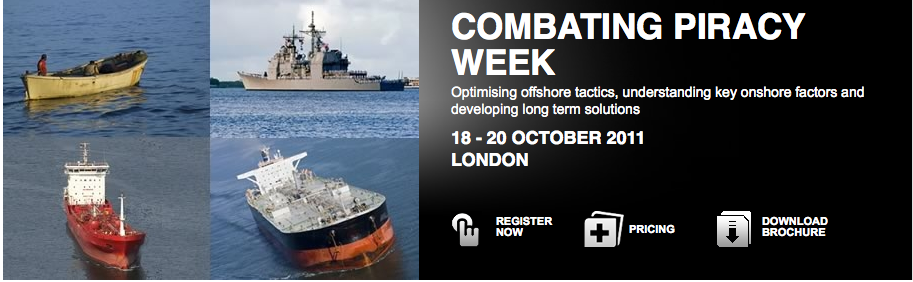 This past Fall, I had the opportunity to speak at Hanson Wade anti-piracy event in London. If you have not attended a Hanson Wade event, they are very worthwhile. I have spoken at literally scores of events over the past 10 years and few, if any, were as well organized. The next event is scheduled for April, 2012 in Hamburg Germany. As luck would have it they have a section on CyberSecurity. Take a look and see if it is worth attending..
Chris Mark in The Maritime Executive August 30, 2011
Posted by Chris Mark in InfoSec & Privacy, Piracy & Maritime Security, Risk & Risk Management.Tags: Chris Mark, cyber piracy, InfoSec, InfoSec & Privacy, Maritime Security
add a comment
Yours Truly (Chris Mark) was interviewed in the current issue (July – August, 2011) of The Maritime Executive on the topic of Cyber Piracy. You can read a summary of the issue here. If you are not a current reader, Maritime Executive is a great periodical with volumes of information on the Maritime industry. You can subscribe to the print edition here.
“Jack O’Connell has explored the Internet underworld with his piece, “Cyber Piracy: Clear and Present Danger?” It’s a dangerous cyber world in which we unknowingly tread, so users beware. Both of these article’s are timely and essential reminders of an Internet moving faster than a speeding bullet.”

 Global Security, Privacy, & Risk Management