Realities of Precision Marksmanship from a Ship… January 26, 2012
Posted by Chris Mark in Piracy & Maritime Security, weapons and tactics.Tags: Chris Mark, mark consulting group, realpolitik, Scout Sniper, sniper
2 comments
This is an excerpt from the post Realpolitik, Piracy and Armchair Quaterbacks. It is intended to supplement the previous post Snipers on Ships…
The article was referring to piracy within the Gulf of Aden and specifically off of the coast of Somalia. In the article, the author writes:
“All we need to do (emphasis added) is declare that for ships on the high sea, a 300-yard radius around the vessels is a limited access zone. Anybody closing in farther without permission will be assumed to be hostile. First, warning shots will be fired across their bow; if this will not do, shoot to kill.
True, this means that merchant ships will need some armed marshals, as do many flights. However, given that the ships are tall and the pirates need to mount them from their small boats, a few armed guards can do the job.”
Here is where theory and practice diverge and armchair quarterbacking takes over. It is easy to be an armchair quarterback (or in this case ship’s crew) when it is not your own very expensive ship on the line or your own life on the line when the RPGs start flying. I can say from personal experience that it is less fun being shot at in real life than the movies may suggest. Additionally, the article ignores the much larger socio-political aspects of piracy.
To understand the feasibilityof what the author suggested let’s dissect what he is saying a little more closely. He states that a 300 yard radius should be imposed around the ships.
In Somalia pirates are attacking ships using small skiffs that often travel over 40 knots (~46 mph). Their skiffs are small, lightweight and agile. The pirates attack ships using multiple boats and primarily carrying RPG-7 rocket propelled grenades, PKM machine guns, and AK-47 assault rifles. They have little fear and are very aggressive. In short, these guys are armed to the teeth and very capable.
On a 30ft x 8ft target moving at 9 mph the US Army gives the RPG 7 a hit probability of 22% at 300 meters, 51% at 200 meters, and 96% at 100 meters. If one considers that the bridge or rudder of ship is the target and doubles the size of the target listed in the Army study, it is fair to say the hit probability doubles, as well. This means that at 300 meters, the pirates have a 50/50 chance of hitting the bridge or rudder and doing serious damage to the ship. If a pirate gets within 200 meters of the ship, their chance of a hit increases statistically to 100%. The answer, according to the author, is to “…fire warning shots across their bow; if this will not do, shoot to kill.”- If they get within 300 meters. The author then goes on to say that: “a few armed guards can do the job.”
As a former Marine sniper with combat experience, I would consider myself competent with a number of different weapons systems. I also have experience guarding ships in Somalia. I can say with absolute confidence that firing: “…warning shots across their bow..” and then: “…shoot(ing) to kill…” at a moving target on the open ocean 300 meters away is a lot easier for action stars like Matt Damon or Sylvester Stallone in thier movies than it is for real people in real situations. In fact, what the author is proposing is very difficult. To demonstrate some of the challenges, let us take a quick look at what is involved.
Consider that you are on a ship which is travelling 10 knots (creating a wind that affects the shot that this article will not address). Consider that you now also have to keep your sights on a very small skiff travelling at 50 knots at 300 meters all while the ship and the boats are bouncing on the ocean swells. Assuming the skiff is traveling parallel with your own boat its relative speed is 40 knots. At 40 knots, the skiff is travelling at almost 67.5 feet per second or the length of a football field every 4.4 seconds. This means that with a .300 Winchester Magnum round travelling 3050 feet per second, a shooter would need to lead the boat 24.25 feet on a stable platform to account for the speed of the boat and the .36 seconds it takes the bullet to traverse the 300 meters (accounting for decease in velocity for you math geniuses). This basic calculation does not account for the vertical movement of the ship or boat or the relative movement between the ship and the boat nor does it account for any wind that may be present. Assuming your target is a person and is 1.2 feet across it is in the ‘hit zone’ for only .013 of a second when travelling at 40 knots. This means that your lead ‘cushion’ is only .9 feet or 10.8 inches. In short, if you lead more 25.04 feet or less than 23.36 feet, you have missed your target completely. If your lead is perfect and you have miscalculated the distance of your target by only 10 meters, you have also missed your target.
Suffice it to say that shooting at a small, high speed target while on a moving platform is more than difficult. It is extremely difficult. Couple this with the fact that the pirates are masquerading as fishermen and you have compounded the issue because nobody wants to make a mistake and hurt an innocent person.
Snipers on Ships….Good Idea…or Overkill? (Pun Intended) January 26, 2012
Posted by Chris Mark in Piracy & Maritime Security, weapons and tactics.Tags: Chris Mark, Maritime Security, mark consulting group, Piracy & Maritime Security, Scout Sniper. Royal Marine Sniper, weapons
add a comment
 I was reading a website today of what appears to be a new entrant into the maritime security world. It is clear that they are trying to differentiate their services by offering ‘Maritime Marksmanship’ services. According to the website, their former Royal Marine Snipers can add protection to 900 meters by adding precision, long range fire. As a former US Marine Sniper I am very familiar with, and have great respect for the Royal Marines’ sniper course and while we like to argue and debate with each other over whose course is superior, the truth is that the discussion is academic. Whether you believe it is the USMC or our UK brethren, the reality is that they are both arguably the most rigorous sniper courses in the world. We will continue to argue 😉 So back to my post.
While I don’t disagree that having trained snipers onboard provides a level of precision shooting, the question that must be asked is “how much is good enough?” The truth is that not a single armed vessel has been successfully hijacked to date. Many of the vessels are armed with M4s (or varients), AK 47s, G3s, FALs etc. Is there truly at need at this juncture for a trained sniper on board? A more fundamental question, I think, is whether you increase liability by placing a sniper onboard. If a pirate is approach a vessel at high speed and shooting then there is a threat. Using the force continuum it is expected that first evasive maneuvers are taken, followed by warning shots etc. If they approach close enough then, possibly, you need to take more direct action and fire at the assailants. International law is still somewhat unclear as to when you can and cannot use deadly force on a suspected pirate. I question what would happen to the shooter if he shot a pirate out of a boat at 900m. It would be extremely difficult to justify such a shooting as ‘defensive’. (I suspect such a shot would be nearly impossible for any trained shooter…see next post as to why).
I believe at this point that having trained Commandos, US Marines (with appropriate background), or other well trained military members provides sufficient protection against pirate attacks. Any Commando, US Marine, Ranger etc. with an M4, or similar weapon system can engage a target to 300 meters with relative ease. Extending this range to a theoretical 900 meters does not, in my mind, reduce risk but may actually increase the risk should a suspected pirate be engaged at that distance.
For companies considering maritime security, it is suggested that the following be considered before considering the more esoteric aspects of armed services.
1) Are the company’s leaders experienced in maritime security and have they established and documented operating procedures consistent with the rules of force and international law? You do NOT want a bunch of gunslinging cowboys on your ships. Consider BlackWater as an example of what happens when undisciplined people with weapons are unleashed.
2) Are the armed guards appropriately vetted and trained? As much as I love my USMC, the fact remains that in the USMC, we have a number of Marines that are cooks, mechanics, etc. In the UK, all Marines are Commando trained. The point being that just because someone has a particular title, does not mean they are right for the job. Ensure that the company is selective and vets their personnel. Additionally, ask about following on training. Are the guards taught the rules of force?
3) Are the guards provided with appropriate kit and weapons? I have heard horror stories of guards being deployed with Moisan Nagant rifles, and other ‘pre WWII’ weaponry. While the debate over whether .50 sniper rifles provide good fodder for arguments, at a minimum the guards need to be armed with effective, modern weapons in working order. M4s, G3, FAL, M14s, AK 74, AK 47 are probably all sufficient to rappel an attack by Somali pirates. I personally do NOT believe that a shotgun is sufficient. A shotgun is great for close quarters fighting but does not have the range or accuracy to defend against an attacker with an RPG or AK 47.
4) Does the company’s principals have experience with maritime traditions, rules, and communications? It is imperative that the guards understand how to work on ships and how to interact with the ship’s officers and crew. Ultimately, it is the ships captain that has responsibility for the vessel and her crew. The guards need to understand how to integrate into the ship’s plans to ensure effective protection of the vessel.
Looking for Expertise? Mark Consulting Group is now open for Business January 25, 2012
Posted by Chris Mark in Uncategorized.Tags: Chris Mark, Heather Mark, mark consulting group, whitepapers
add a comment
 As a professional consultant, entrepreneur, and executive, I have decided to once again hang a shingle and open my newest venture Mark Consulting Group. Unlike other companies I have founded, this will remain a boutique consulting operation focused on helping companies with strategy, marketing, bizdev, operations, branding, and the like. We have significant social media expertise and the other principals bring a variety of unique skills to the table. Our objective is simple. To help you increase revenue through increased business or retain more profit through increased operational efficiencies. Either way, your business is more successful. Please take a moment to review my website and if you have a particular need, please don’t hesitate to contact me directly. We have work samples on the site. http://www.markconsultinggroup.com
From Fragmentation to Consolidation- The Inevitable Shake-out of Maritime Security January 22, 2012
Posted by Chris Mark in Industry News, Piracy & Maritime Security.Tags: Chris Mark, competitive strategy, five forces model, mark consulting group, porters five forces
1 comment so far
 Over the past year the maritime security industry (anti-piracy) has changed significantly. While pirate attacks continued to increase through 2011, successful (in the view of the pirates) hijackings began to taper-off then decline toward the end of 2011. By December 2011 attacks were down 65% and actual hijackings were down 85% from November, 2010 (read the post here). The decline in successful hijackings can be attributed to a number of factors including adoption of BMP4, use of armed guards, convoys and so on. Regardless of the reasons, from a market perspective the impact is the same.
Within the same time period the entrants into the anti-piracy arena increased an estimated 4 fold. From the early days of RedFour, PVI, Trident and Nexus came a new rash of entrants as every former Marine, Commando, SEAL and other tactically minded person was attracted to the seemingly easy revenue present in the industry. A look at the ICOC membership as of December 1st, 2011 shows 266 signatories. Using the ICOC as a barometer one can see the explosive growth. On November 9th, 2010 the ICOC had 13 signatories. 13 more signed on February 1st, 2011. 24 more signed in April, 2011, and so on. Of the 266 signatories over 150 appear to provide Maritime Security services. Considering that there are numerous companies that have not yet signed, it is fair to assume that the number of Maritime Security Companies now stands at about 200.
While this is not a class on Porter’s Competitive Forces, there is some value to be garnered from Porter’s studies. Porter made it clear that choosing a firm’s relative competitive position within a selected industry is a decision of secondary importance. The 5 forces provide a framework which allows for the identification of the anticipated profitability within an industry or segment and help companies stake a position within the industry. A very quick, high-level analysis of the market shows that we are headed for the inevitable shakeout and consolidation of the market. Currently, the large number of competitors jockeying for position means that the maritime security industry appears fragmented but this is only temporary and does not tell the full story. I say ‘appears’ because concentration ratios and other factors tell a different story. For those who study competitive theory a fragmented market is good as it generally indicates a profitable industry.
Porter’s framework consists of five fundamental competitive forces. Commentary has been added to each to show the movement toward consolidation.
1. Entry of competitors– assessing the ability of new entrants to start operations and the structural barriers they must overcome; (Comment) The less the barriers to entry, the greater number of competitors will enter the market driving prices down as competition increases. It should be noted that the barrier to entry to ‘creating’ a maritime security company is low however the barrier to entry in successfully operating a company is high. There is quite a bit of noise caused by entrants that have no capability to actually deliver on maritime services they are selling.
2. Threat of substitutes–assessing the ability of new products with superior characteristics to replace existing product(s) or service(s); (Comment) While armed guards seem to be the panacea of security, BMP4 and other tactics are proving effective, as well leading some to question the need for armed guards.
3. Bargaining power of buyers– assessing the relative strength and number of buyers;* (Comment) the disparity in the size of the buyers (shipping companies) and the suppliers (armed security companies) coupled with the large number of entrants creates a situation in which buyers have strong bargaining power. Prices continue to drop.
4. Bargaining power of suppliers– assessing the relative strength and number of sellers;* (Comment) with the exception of the few large player, suppliers generally have little, if any bargaining power.
5. Rivalry among the existing players– assessing the relative competitive strength of rival firms.* (Comment) There is increasing rivaly among the players as new entrants enter the market. Several large players are beginning to predominate the industry showing a trend toward consolidation.
* Concentration ratio (CR): the percent of market share held by the four largest firms within an industry is frequently used as a leading measure. A high CR means that few firms hold a large market share, are less competitive, and create a less competitive, more monopolistic landscape. Less competition leads to higher profit margins. A low concentration ratio indicates that an industry is characterized by many rivals, none of which has a significant market share. These fragmented markets are said to be competitive. (Comment) Going back to my previous statement. There are a huge number of new entrants but the vast majority of these companies are simply ‘hoping and praying’ that they can land a client. Some companies have managed to sign clients only to realize that they cannot operationally support the clients.
It should be noted that the decrease in hijackings is anticipated to result in a reduction in the demand for armed security. (at least temporary reduction until an event such as an increase in hijackings causes an new demand). Additionally, the increasing number of entrants is going to continue to drive profit margins down until there is a shakeout in the market. It is a fair assumption at this point to say that within the next 12 months, an estimated 50% of the maritime security companies within the industry will be nothing more than a vanity company (no business just a name) or will be out of business while the major players with the operating capital, economies of scale, and operational expertise will survive the shakeout and continue to grow as the industry continues to consolidate. The end result with be a more mature, disciplined industry with fewer entrants and more consistent profit margins. Unfortunately for the vast majority of industry entrants, their foray into the market will likely be short lived as they are either forced out, or acquired by the larger competitors as the market continues to consolidate.
Costa Concordia Runs Aground; 3 Dead Scores Missing January 14, 2012
Posted by Chris Mark in Industry News.Tags: Chris Mark, costa concordia, mark consulting group, markconsultinggroup.com, ship aground
add a comment
 This is a tragic story but one that is worth reading. Read MSNBC here. The Costa Concordia ran aground off Italy today and at least 3 are confirmed dead and scores missing. You have to see the pictures. Unbelievable to see a ship of her size run aground. Hopefully, the casualties will be minimized but from the look of the ship it seem unlikely that they won’t be significant.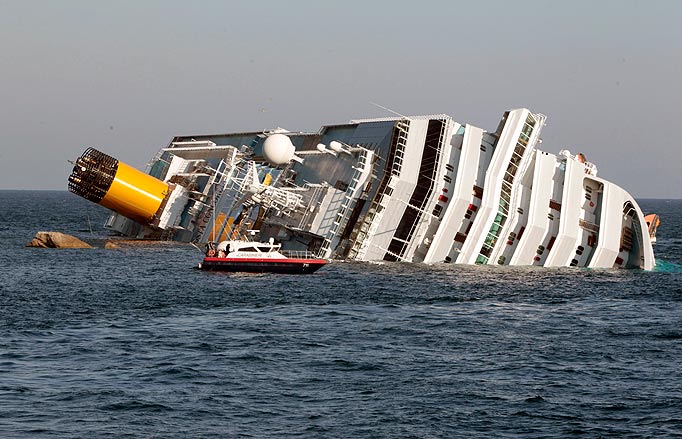

 Global Security, Privacy, & Risk Management